
Stiletto Carpenter and Trim Squares

Stiletto Carpenter and Trim Squares
Stiletto is a name synonymous with titanium hammers, which they introduced to the trades. Rob is a big fan of the Stiletto TIBONE hammer, and I’m a big fan of their TRIMBONE hammer (my review of an earlier version here). Milwaukee Tool bought Stiletto in 2007 and has been expanding their offerings ever since.
A while ago they brought a 7” rafter square (which they call a “carpenter square”) and a 4½” trim square to market. These haven’t gotten as much press as I think they deserve, so we requested samples for this review.
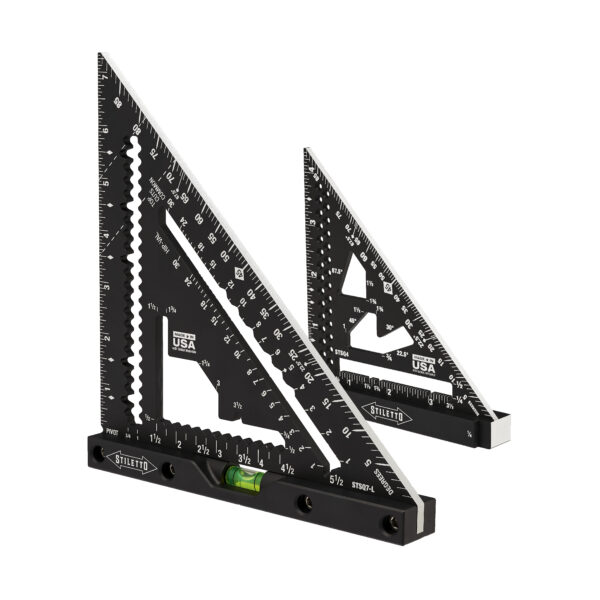
Note: everyone knows what it’s like to use rafter and trim squares; here I’ll just be describing the features and capabilities of these Stiletto squares that I thing set them apart. The manufacturer’s photos do an excellent job of showing them, so I’ll just use those to show these features.
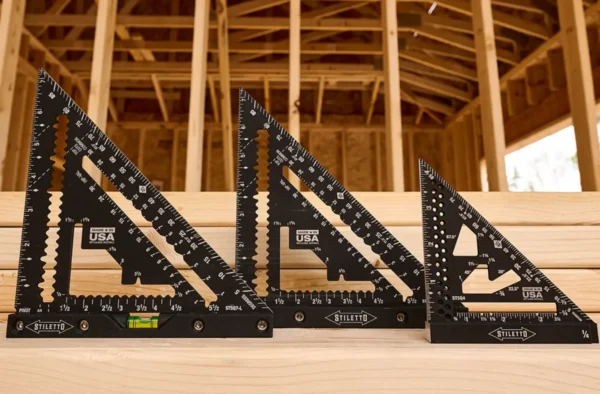
Premium Products
Stiletto makes premium products from premium materials with premium features that – no surprise — command a premium price. Below I explain why that premium price is irrelevant to a pro that uses the premium features, but first let’s get into the features that set these squares apart from the rest of the field.
Stiletto 7-inch Carpenter Square
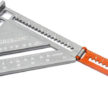
In addition to the usual pitch, angle, and inch indices, and seat cut guides, the Stiletto STSQ7 Carpenter Square features include:
- Fully machined from thick 190-thousandths aluminum
- Integrated level
- Anti-glare anodized finish
- Bottom heel markings
- Extremely visible laser-etched white-on-black indices
- Bottom heel markings
- Scribe notches every 1/8-inch
- 2 ounces
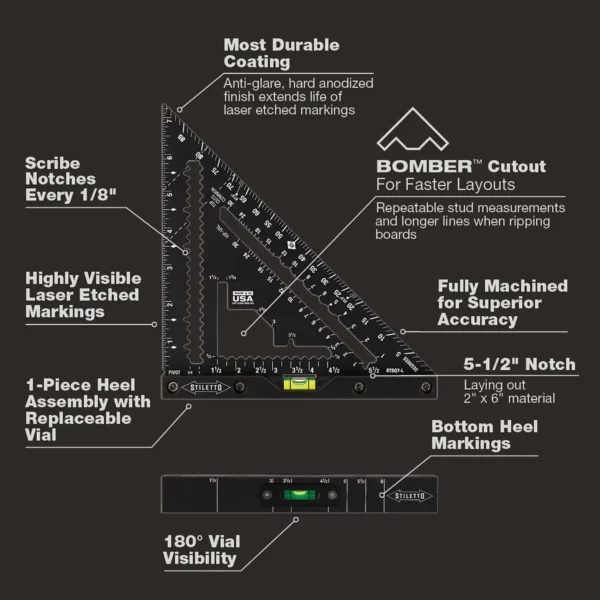
And then there’s the center “bomber” cutout (so named because it resembles the B1 Stealth Bomber) that incorporates many premium features, including:
- Marking guides and indicators for laying out traditional 2x4s and 2x6s, LVLs, and even some trim.
- Specifically: 1½, 1¾, 3,, 3½, 5½, and even ½ and ¾-inch marking guides and indicators.
- These guides and indicators are in both the X and Y dimensions
- More scribe notches along the heel
Just look at the pictures of this square for a bit; it’ll take you a couple minutes to see and process all the features packed into this tool.
Premium Performance
This is a rafter square for pros who can take advantage of the features it offers, as well as anyone who just enjoys working with fine tools. The benefits of some of the features included in this square are obvious (all those scribe notches, for example), but a couple deserve a comment.
The prolific marking guides and indicators make layout, especially of stud packs, easier and more accurate. That layout marks are also on the heel is very handy. If you are working with LVLs (and everyone who isn’t, soon will be) this square has indicators for LVL layout, which most rafter squares don’t (and in both the X and Y dimension, too). This alone is huge.
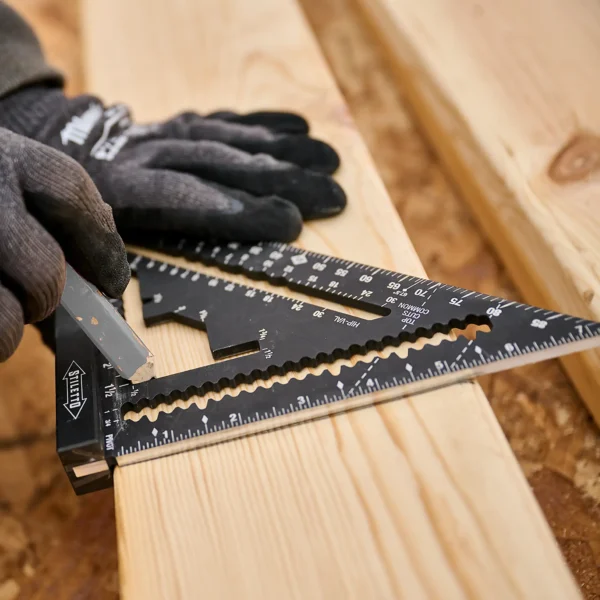
The integrated replaceable level, which is almost 360-degree visible, obviously eliminates the need to carry a torpedo level. This feature is what I call “functionally free” in that it comes with no trade-offs. Also having the level built into the square is very handy for those of us that work on old houses. Sometimes the construction in them is a marvel of standardized precision…and sometimes it’s whatever felt good to the carpenter that day. When you need to determine, for example, the pitch of a roof, in some cases you can simply hold the Stiletto Carpenter Square up to a rafter; when the heel is level you can read the pitch directly from the scales (see photo below).
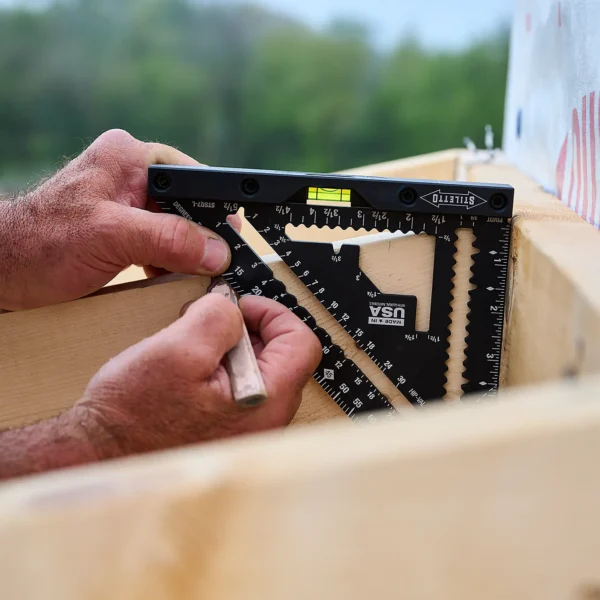
To house the level vial, this square has a two-piece construction. The thick, robust heel is fastened to the body with Allen screws. Don’t worry about them coming loose; I applied a lot of force to an Allen wrench to see if they’d budge, and they didnt even a smidgen.
Anything Not to Like?
No, but two things are worth noting about the Carpenter Square. First this square is a little heavier than many others. I like that the heft provides more tactile feedback, though.
Second, there’s so much information on this square that it can be busy to read at first. If you use it frequently though, it’ll all become second nature.
Stiletto 4½-Inch Trim Square
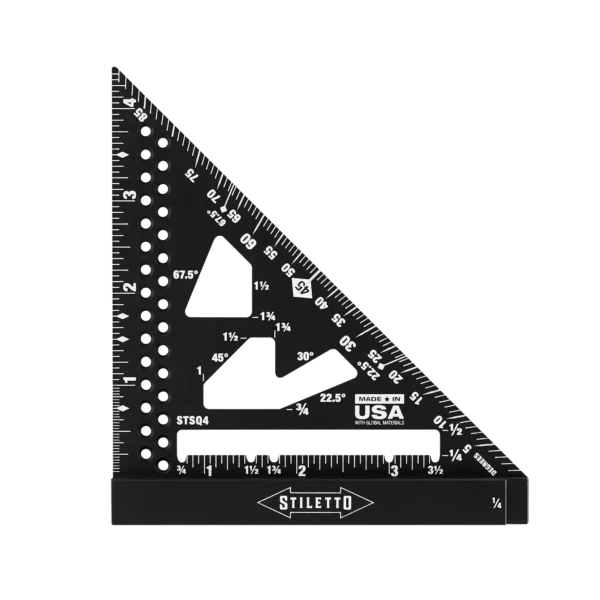
The Stiletto STSQ4 trim square is another premium tool. Like its big brother it is crammed full of capabilities that most trim squares don’t have. In addition to inch and angle indices, it features:
- Fully machined aluminum construction
- Anti-glare hard anodized finish
- Hi-vis white-on-black laser etched markings
- Scribe holes every 1/8-inch
- Fully ruled bottom heel
- Reveal gauges of 1/4- and 3/16-inch
- Center cutouts with 5, 45, 30, and 22.5-degree guides
- Layout guides and notches at ¼, ½, ¾, 1½, 1¾, 3, and 3½-inches (in both X and Y dimensions)
Again, you need to look at the photo of this square for a few minutes to take it all in!
Premium Features
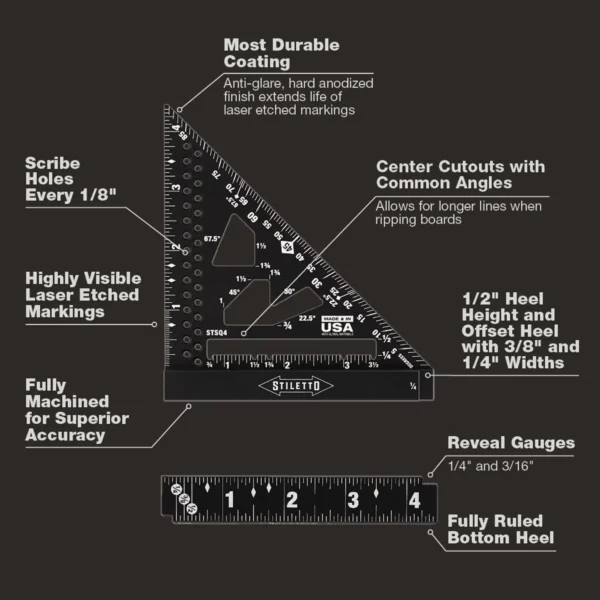
Like the larger Carpenter Square, the Stiletto Trim Square has a nice heft for its size that feels good in the hand. Features that make this a premium product include:
The copious scribe holes every 1/8-inch are welcome for trim work where we deal with smaller dimensions.
The four angle guides are unusual and useful for trim work, where bevels of these angles are pretty run-of-the-mill.
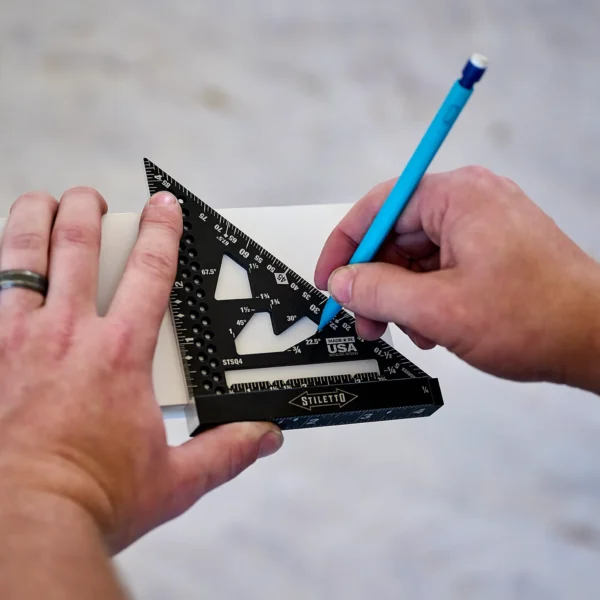
The layout notches make this small square capable of doing common layout tasks, so you get both trim and framing capabilities in one compact tool.
The fully ruled heel is both useful for layout and setting table saw height.
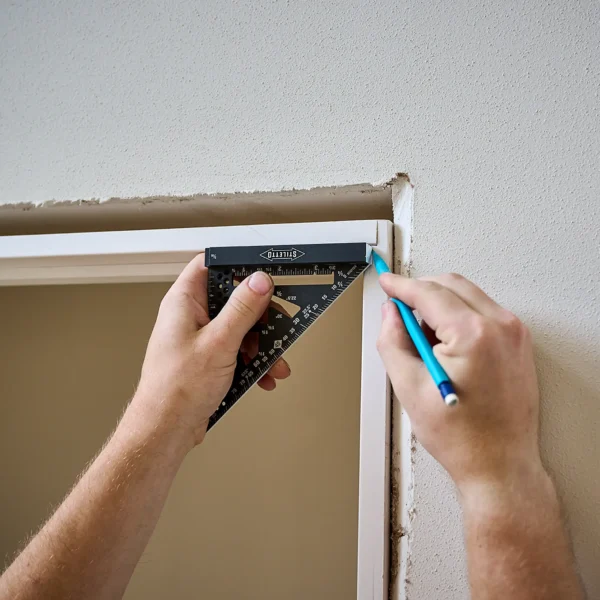
Finally the 1/4- and 3/16-inch reveal gauges are incredibly useful for scribing reveal margins on doors, windows, and other trim see image below). These alone are worth the price of the Stiletto trim square to my mind, because it’s so easy to wind up with reveals that are sloppy.
Penny Wise & Pound Foolish
This Stiletto carpenter square is expensive – no way around that. It runs about $130 as of this writing. The Trim Square runs about $80. But as described, in addition to its extremely high build quality, these have functions and capabilities that most squares of their type don’t. If you don’t need these enhanced features, then Milwaukee, the parent company of Stiletto, makes an excellent rafter square that we described here, which runs about $20, as well as an excellent trim square. But focusing on the Stiletto Carpenter square: is it really worth the $110 difference?
First, since your tools are tax-deductible expenses, that $110 difference is more like $77 out-of-pocket. That’s not much to pay for features that you need, or that make your job faster or more convenient. Second, unless you work in a very harsh environment, this square will last you many years. Finally, your spending should prioritize high quality in those tools that you use many times every day, because small annoyances or inefficiencies compounded over days, weeks, and years add up to real aggravation. If a rafter square is in and out of your hands many times a day, than the Stiletto carpenter square is a wise buy. Ditto reasoning for the Stiletto Trim Square.