
Milwaukee Framing Squares

Milwaukee Framing Squares
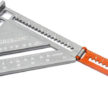
Best-in-Class 24 x 16 Framing Square
Every carpenter has a framing square because every carpenter needs one. Not just framers, but anyone who makes things with wood, from finish carpenters to form setters.
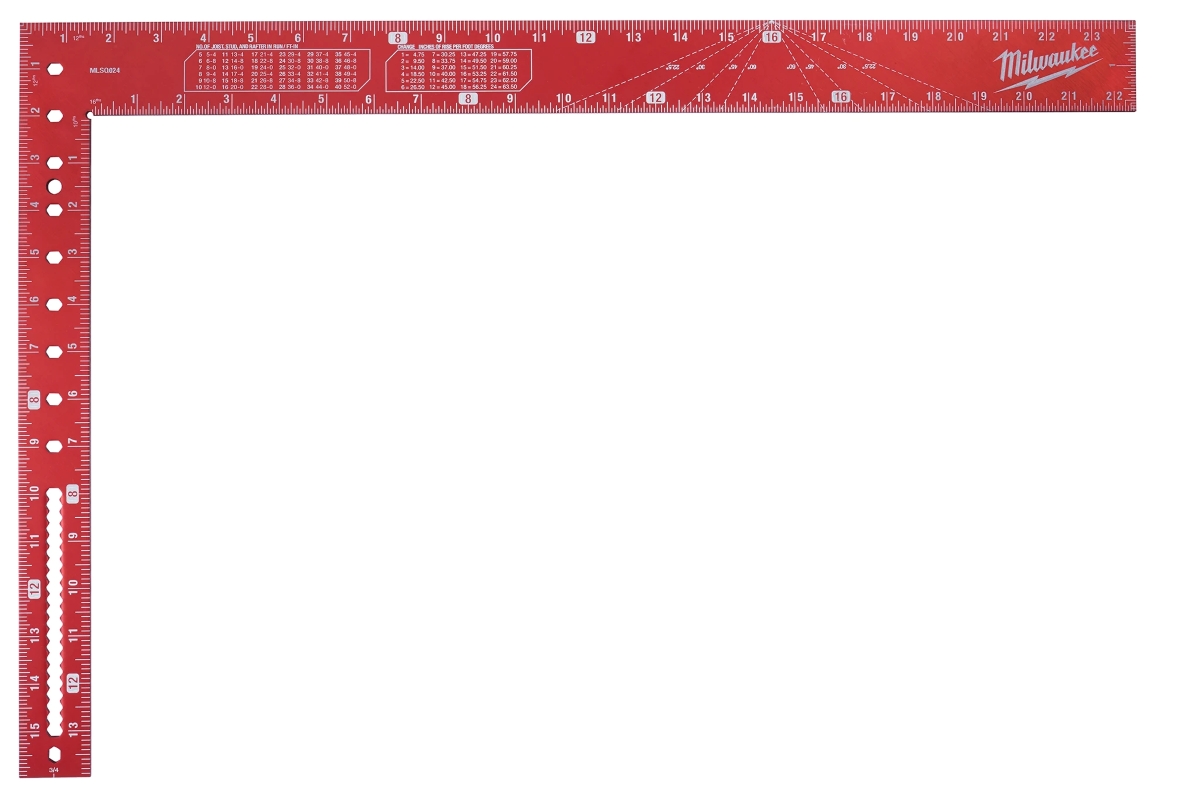
Milwaukee supplied us with three of their framing squares for review, including the made-in-the USA MLSQ024 24”X16” framing square. I regard this square as best-in-class.
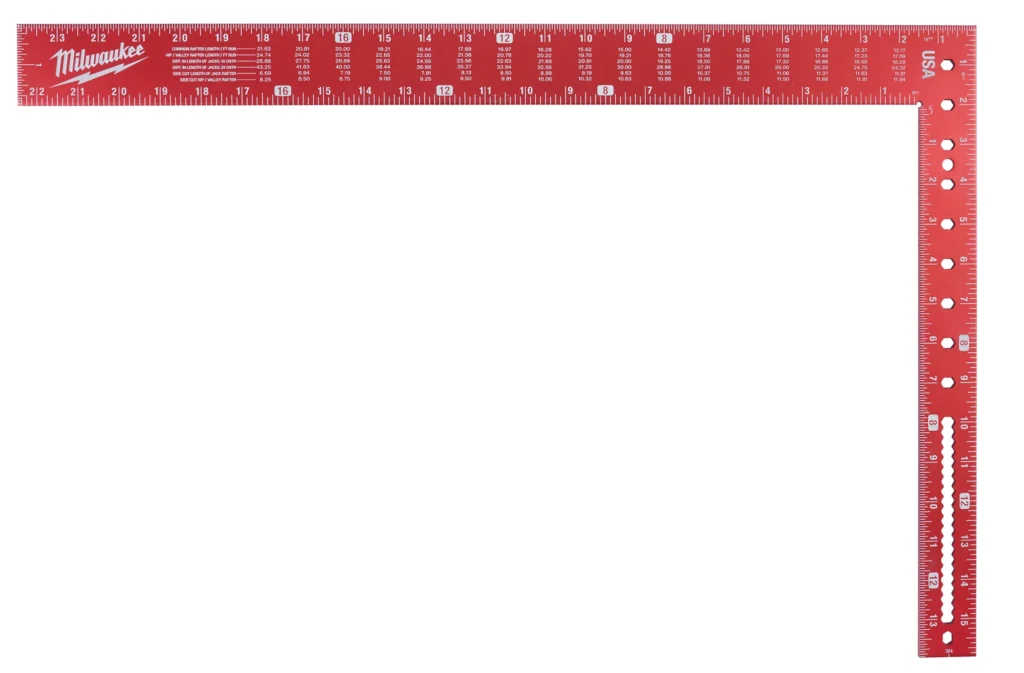
Here’s why:
- It’s 3/16-inch thick – 50% thicker than most others. It resists bending and warping, and won’t go out-of-square when dropped.
- It’s light weight (1.08 pounds), but has just the right amount of heft to provide tactile feedback, something that light framing squares don’t.
- It’s made of aluminum, which doesn’t rust. Aluminum also heats up less in the direct sun and returns to ambient temperature sooner in the shade than steel does.
- The red anodized finish is easy to see, easy to find on a jobsite, doesn’t absorb as much heat as black would, and is usable in direct sunlight, unlike bare metal squares (see photo below) . The white-on-red markings are easy to read.
- Its markings are laser-etched. They are impervious to solvents, which applied markings aren’t (a framing square will be exposed to adhesives, caulk, tar and all kinds of goop). They are also more accurate.
- It has 8ths, 10ths, 12ths, and 16ths scales. The 10ths and 12ths scales are necessary for reading plans.
- It incorporates scribe notches from 1- to13-inches on the tongue.
- It has common angle indices
- It comes with a lifetime warranty.
- $31 at The Home Depot.
Additional features include rafter, slope-to-degrees, and stud layout tables.
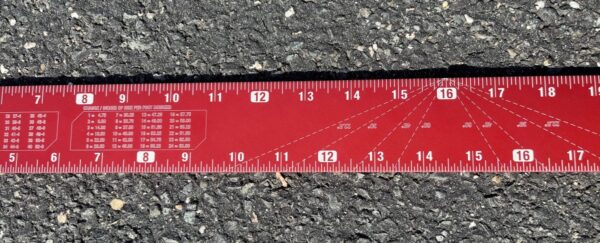
I took this photo in the direct sun from the angle of the greatest glare
Hand Tools from a Power Tool Vendor?
Conventional wisdom has been to buy tools from a vendor that specializes in that kind of tool, and Milwaukee is certainly a top-tier power tool vendor. But Milwaukee has also been selling very highly regarded tape measures, gloves, and many other hand tools for a long time (there are nearly 800 of them on the Milwaukee website), and even work clothing (Rob and the crew are big fans). Indeed, some of their MiUSA tools that I reviewed are in the very top echelon for their type. So sure: Milwaukee makes great hand tools.
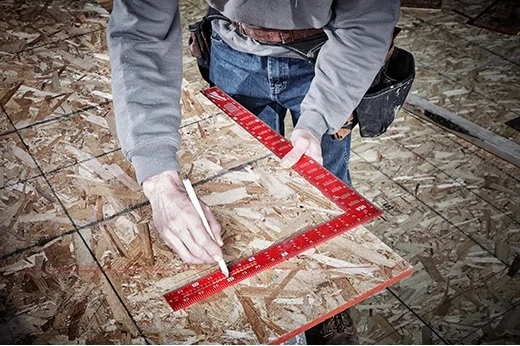
Aren’t Framing Squares Obsolete?
Humans have been making complex structures for at least 10,000 years, and we know they’ve been using framing squares to construct them for at least 5000 years, because they were used in the building of the great pyramids. And while the modern framing square has been around for about 150 years, they are still not anywhere near obsolete.
Haven’t compact rafter squares replaced large framing squares? No. While rafter squares carry comfortably in a tool pouch, and have some layout features that framing squares don’t, framing squares are still essential on the jobsite.
- They are necessary to square up anything longer than, say, 12-inches. Framing members to be sure, but also doors, walls, cabinets, counter tops…the entire gamut of things that carpenters work with.
- They are more accurate than rafter squares.
- They can be just as fast to use as a rafter square, even for laying out rafters, particularly if you’re doing your roof cutting on the ground.
- They are the right tool for laying out stringers.
Also, a framing square is much better at teaching a newbie what’s going on in rafter layout. If you clamp a straight board to your pitch indices (see photo below) so that it depicts the running edge of a rafter, it’s much easier to see the relationship of marks and cuts to plum and level than with a rafter square.
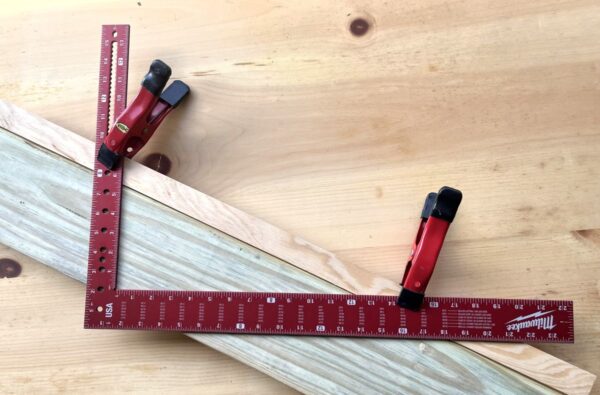
What are no longer necessary are the tables that are printed on the blade and tongue of many framing squares. Reference books, construction calculators, and phone apps are what most carpenters use today. Even a 50-cent calculator from the dollar store will do most of the math that the tables were originally put there to do. As a nod to tradition, Milwaukee chose to include some on this framing square. Of course, those tables don’t do any harm, and knowing how to use the rafter tables will give you a better understanding of framing (and an appreciation of how your predecessors worked).
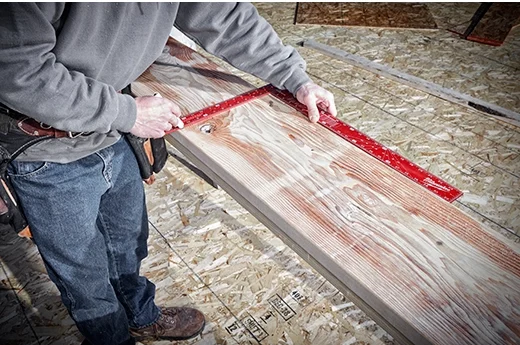
Is it Accurate?
You can see in the photo below that lines, drawn with a fine 0.5mm mechanical pencil, along the blade when the tongue was against a factory straight edge, and then the square flipped, show no deviation (there are two lines there!). Is this accurate enough?
Now, you’ll read people on line complaining that a framing square was out of square by a couple thousands over the 24-inch length of the blade. This is almost beyond parody.
- You’re framing a building, not fabricating the International Space Station.
- You are working with wood, an organic material that swells, expands, contracts, and shifts around.
- Your cut line is marked with a carpenter’s pencil which is 100 thousandths thick. At best, you’re using a 0.5 mm mechanical pencil to strike a line, which is 20 thousandths thick (and if you’re using that fine of a pencil for framing, Ricky Ricardo would like a word).
- The line that the square defined will be cut with a circular saw, which has a kerf of 125 thousandths, and also has some inevitable chatter and runout. Plus no one can hold a saw to a line while cutting to anything approaching 20 thousandths anyway.
So yeah, this Milwaukee framing square is superbly accurate for its task.
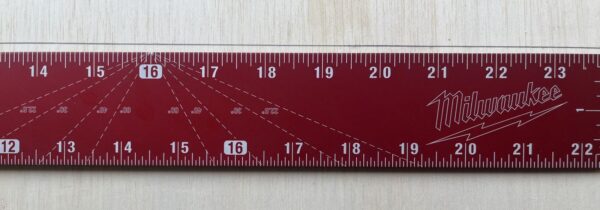
Using the Milwaukee Framing Square
This isn’t a tutorial on how to use a framing square – there are many of those online. I just want to report on what it feels like to use this square.
- As mentioned above, the 3/16-inch thick aluminum provides the ideal weight and feel in the hand for this kind of tool. It’s livelier than my dad’s all-steel square (see below) and provides much better tactile feedback than thinner aluminum squares. The white-on-red marking are easy to see.
- The 8ths, 16ths, 12ths and 10ths scales are clearly marked as such. In some squares they aren’t, which inevitably creates confusion and mistakes.
- It feels like a real tool, with a reassuring sturdiness.
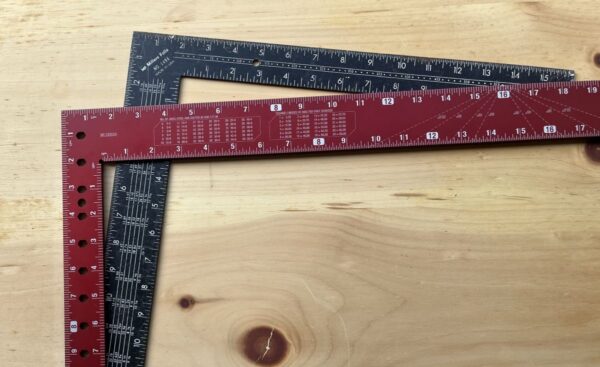
For all these reasons, you can see why I call this framing square best-in-class. You can buy more expensive ones (some much more expensive) and cheaper ones, but for about $30 (short money) this Milwaukee framing square will be a joy to use for both you and whomever you hand it down to.
Other Milwaukee Construction Squares
MLSQ812 8” x 12” Framing Square
Milwaukee’s smaller cousin to the above framing square is their MLSQ812 8”x12” framing square. It features the same 3/16 thick aluminum construction with lots of scribe notches and holes on both the blade and tongue, and 8ths, 16ths, 10ths, and 12ths scales. It has the same hi-vis laser-etched markings, is also made in the USA, and has a lifetime warranty.
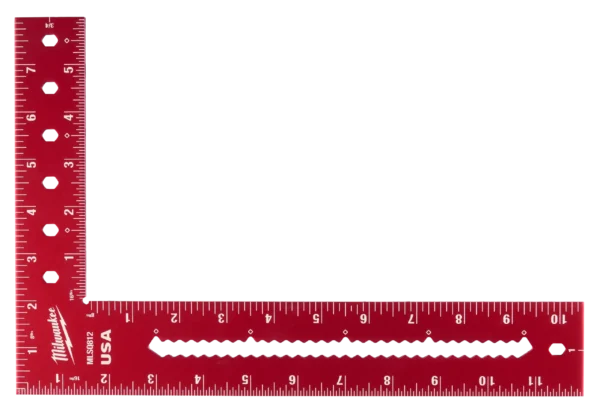
This is an extremely handy sized square for when a traditional framing square is too cumbersome and a rafter square not quite the right tool. On a recent deck build I had to incorporate a drainage access panel, and this square would have been exactly the tool for the layout. Sure, I managed just fine with out it, but there’s great satisfaction in using just the right tool for the job. It’s only $18 at The Home Depot, and thus an easy add to your tool box.
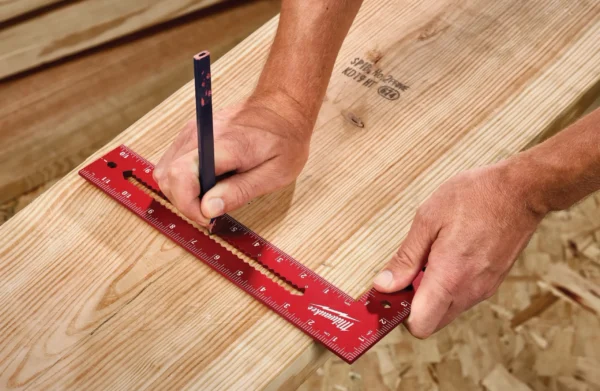
MLSQ070 7” Rafter Square
Milwaukee’s offering in the 7-inch rafter square market is their MLSQ070, which can be picked up for $21 at The Home Depot. This is a very sturdy rafter square, fully machined from aluminum that, to my hand and calipers, is just slightly thicker than the 3/16-inch thickness of the two above framing squares. In addition to the normal pitch and angle indices, it has scribe notches all the way from 1” to 6” – more than many rafter squares – which is a very valuable feature. It has Milwaukee hi-vis white-on red markings, and a 1-inch square cutout that allows the square to function as a pipe prop.
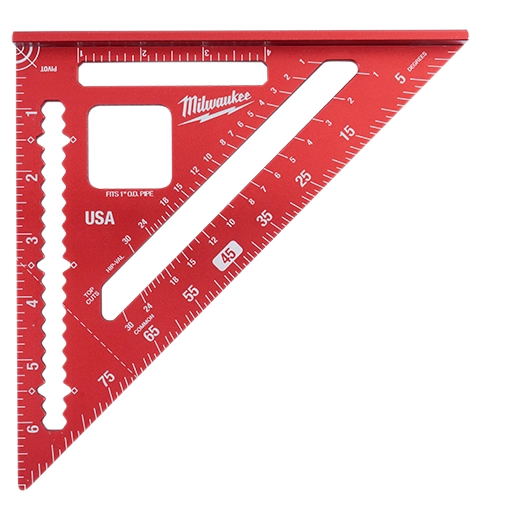
In addition to the extensive scribe notches, the other outstanding feature of this rafter square is its 1 1/8-inch heel – to my knowledge the widest in the industry. It’s not so wide that it gets in the way in a tool bag, but that extra width is quite welcome when working with radiuded edge lumber or round material such as pipes. If you don’t need the premium features found in Milwaukee’s line of Stiletto rafter squares, this Milwaukee square can’t be beat.